 Hair Transplant
  Dental Aesthetics
  Facial Aesthetics
  Body Contouring
  TMJ Treatment
  Eye & Eyelid Surgery
  Mummy Makeover
  Obesity Treatment
  Orthopedics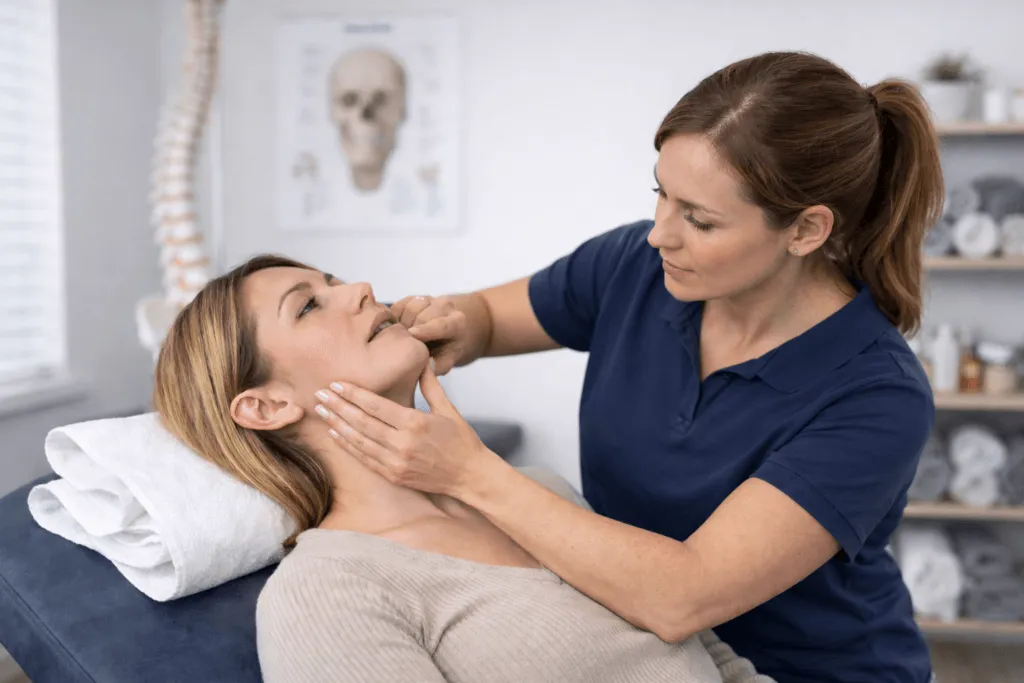
TMJ physiotherapy is a structured, hands-on and exercise-based approach to temporomandibular disorders. It combines assessment of jaw movement, manual therapy to the chewing muscles and joints, a prescribed exercise programme, and retraining of the habits and postures that keep symptoms going. It is most useful where pain comes from overworked muscles, where mouth opening has become restricted, or where a period of guarding after a flare has left the jaw stiff. Physiotherapy is non-invasive and is often run alongside splint therapy rather than instead of it.
Is this treatment right for you?
Suitable for: adults with muscle-related jaw and facial pain, restricted or uneven mouth opening, jaw stiffness after a flare, or neck and posture factors that contribute to their symptoms.
Less ideal if: your jaw is acutely locked and has not been assessed, your symptoms followed a recent injury, or you have an untreated dental infection or a suspected fracture, all of which need clinical assessment before any exercise programme.
Suitability can only be confirmed by a qualified clinician after assessing you, which is why every plan begins with a free, personalised review rather than a fixed promise.
Benefits & risks
A balanced view matters more than a sales pitch. Weigh both sides and discuss them with a clinician before deciding.
Potential benefits
- Aims to reduce muscle pain and tenderness in the jaw, temples and neck
- Can improve how far and how evenly the mouth opens
- Non-invasive, with no injections, anaesthetic or dental work involved
- Teaches self-management you can continue at home between and after appointments
- Addresses contributing factors such as posture, neck tension and daytime clenching
- Works well alongside splint therapy and, where used, injection treatment
Risks & considerations
- Temporary soreness or a short-lived flare of symptoms after manual therapy
- Exercises done too forcefully or too often can aggravate rather than settle the jaw
- Improvement depends heavily on doing the programme consistently at home
- Not all temporomandibular disorders respond — some need injections or a joint procedure
- Progress can be slow, with symptoms fluctuating over several weeks
- Neck and jaw manual therapy is avoided or modified where there is an underlying medical reason
Am I a candidate?
- Your pain is mainly muscular, or your jaw feels stiff and restricted rather than locked
- You have been assessed and no urgent dental or joint problem needs treating first
- You are able and willing to carry out a daily home exercise programme
- You accept that improvement is gradual and measured over weeks rather than days
- You are happy to continue the programme remotely once you return home
Only a qualified clinician can confirm suitability after a personal assessment.
Process & recovery
A physiotherapy assessment measures how far and how symmetrically your jaw opens, examines the chewing and neck muscles for tender points, and looks at posture, breathing and habits such as daytime clenching. Treatment typically combines manual therapy — soft-tissue work to the masseter and temporalis muscles, gentle joint mobilisation and trigger-point release — with a graded home exercise programme for controlled opening, jaw stability and neck mobility. Heat, self-massage and habit retraining are taught so you can continue at home. Sessions are usually short, and a course runs over several weeks, so an initial block is carried out in Türkiye and continued remotely. Effects are generally mild: temporary soreness after manual therapy, a short-lived increase in symptoms after a session, and — where exercises are done too vigorously — a flare rather than an improvement.
What TMJ physiotherapy involves
Physiotherapy for a temporomandibular disorder treats the jaw as part of a system rather than as an isolated joint. The chewing muscles, the joints themselves, the neck and the habits of daily life all feed into how the jaw feels, and an assessment looks at each of them: how far and how symmetrically you open, which muscles are tender, how you hold your head and shoulders, and whether you clench during the day without noticing.
Treatment then has three strands that work together — hands-on therapy in the clinic, exercises you carry out at home, and changes to the habits that keep symptoms going. None works especially well alone, which is why a programme is planned as a course rather than a single appointment.
The three strands
Manual therapy
Soft-tissue work to the masseter and temporalis muscles, trigger-point release, and gentle mobilisation of the jaw joints are used to reduce muscle tenderness and improve movement. Work on the neck and upper back is often included where posture or neck tension is contributing. Some tenderness for a day afterwards is common.
Exercise
Exercises are graded and specific: controlled opening within a comfortable range, movements that train the jaw to open evenly rather than deviating to one side, gentle stretches, and neck mobility work. They are taught in the clinic and then done in short, frequent sessions at home. Doing them gently and often works better than doing them hard and occasionally.
Habit and posture retraining
A large part of muscle-related jaw pain comes from what the jaw does all day. Resting the teeth slightly apart, keeping the tongue on the roof of the mouth, noticing clenching during concentration or stress, avoiding gum and hard or chewy foods during a flare, and setting up a workstation that does not push the head forward all reduce the load on the system.
What to expect over a course
| Stage | What is typical |
|---|---|
| First sessions | Assessment, measurement of jaw opening, initial manual therapy and two or three starter exercises; mild soreness afterwards is common |
| Weeks 2–4 | Exercises progressed, habit changes established; muscle tenderness often begins to ease before opening improves |
| Weeks 4–8 | Range of movement and function reviewed; the programme is adjusted, reduced or, if there has been no meaningful change, reconsidered |
| Longer term | A short maintenance routine, used particularly during stressful periods or after a flare |
If a reasonable trial of physiotherapy produces no change, that is useful information rather than a failure: it points towards reassessment and, in some cases, towards other TMJ treatments such as injections or a joint procedure.
Having TMJ physiotherapy in Türkiye
As a medical travel facilitator, we coordinate TMJ physiotherapy at accredited, Ministry of Health–authorised partner clinics in Türkiye, usually as part of a wider plan that may also include assessment, imaging and splint therapy. Because physiotherapy works over weeks rather than days, the intention is to complete a thorough assessment and an initial block of sessions during your stay, and to send you home with a written programme and remote follow-up rather than a course you cannot finish.
Packages are all-inclusive and transparent, typically covering treatment, hotel accommodation, airport and clinic transfers, and an English-speaking coordinator at every appointment — see your patient journey for how a typical visit is organised.
This page is for general information and is not a substitute for personalised medical advice; suitability can only be confirmed after an individual assessment.
Frequently asked questions
What happens in a TMJ physiotherapy session? +
A session usually begins with measurement of your jaw movement and examination of the chewing and neck muscles, followed by manual therapy such as soft-tissue release and gentle joint mobilisation. You are then taught exercises to practise at home and given advice on posture, habits and heat. Sessions are generally short, and much of the benefit comes from the home programme between them.
How many sessions will I need? +
It varies with the diagnosis and how long symptoms have been present. A course often runs over several weeks, so an initial block of sessions is carried out during your stay in Türkiye and the programme is then continued at home with remote review. The treating physiotherapist will set out an expected number at your assessment rather than committing in advance.
Can physiotherapy replace a splint? +
Sometimes, but the two are more often combined. A splint manages the load from night-time clenching, while physiotherapy addresses muscle pain, restricted movement and daytime habits. Which is appropriate — or whether both are — depends on your assessment.
Should the exercises hurt? +
No. A mild stretch or brief soreness after a session can be normal, but exercises should not cause sharp or lasting pain. Jaw exercises done too forcefully are a common reason for a flare. If an exercise consistently makes symptoms worse, stop and report it rather than pushing through.
How long do I need to stay in Türkiye? +
For an assessment and an initial block of sessions, a stay of around three to five days is typical, often combined with a splint fitting if one is planned. The remainder of the programme continues at home. Your personalised plan confirms the schedule.
Does neck treatment help jaw pain? +
It can. The neck and jaw share muscular and postural connections, and neck tension, forward head posture and prolonged screen use are common contributors to jaw symptoms. Assessment therefore usually includes the neck and upper back, and treatment may address them alongside the jaw.
When will I notice a difference? +
Many people notice some easing of muscle tenderness within the first two to three weeks, with mouth opening improving more gradually. Longstanding symptoms generally take longer. Progress tends to fluctuate, and a good week followed by a worse one does not mean the programme is failing.