 Hair Transplant
  Dental Aesthetics
  Facial Aesthetics
  Body Contouring
  TMJ Treatment
  Eye & Eyelid Surgery
  Mummy Makeover
  Obesity Treatment
  Orthopedics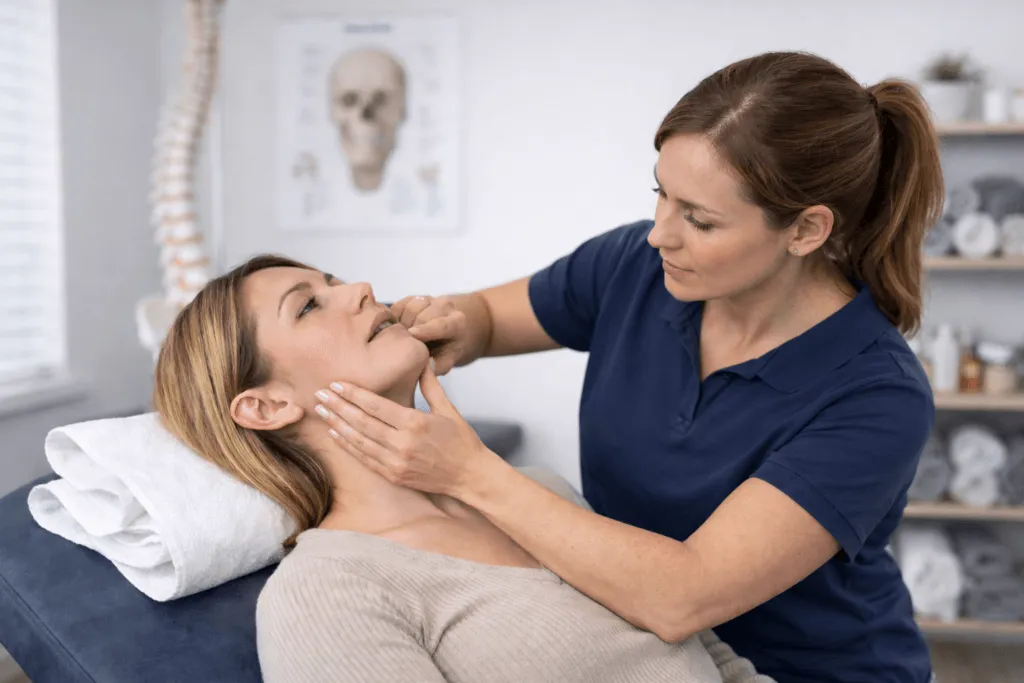
TMJ treatment covers the care of temporomandibular disorders — problems affecting the jaw joints in front of the ears and the muscles that move them. Typical symptoms include jaw pain, clicking or grating, headaches around the temples, earache, difficulty opening wide and a jaw that locks or feels tired after chewing. Most cases improve with conservative measures such as an occlusal splint, physiotherapy, medication and habit change, and only a minority need a procedure inside the joint itself. Health Clinic coordinates your assessment and treatment with qualified maxillofacial and dental specialists at accredited, Ministry of Health–authorised partner hospitals and clinics in Türkiye, from first assessment through treatment to aftercare, with an honest account of what each step can and cannot achieve.
Procedures in this area
Each procedure explains what is involved, who it may suit, recovery and a balanced view of benefits and risks. A clinician confirms suitability after a personal assessment.
Occlusal Splint Therapy
An occlusal splint — often called a bite guard or night guard — is a custom-made appliance worn over the upper or lower teeth to manage the effects of clenching and grinding.
Botulinum Toxin for Jaw Clenching
Botulinum toxin injections into the chewing muscles are used to reduce the force of severe clenching and grinding when a splint, physiotherapy and habit change have not brought enough relief.
TMJ Physiotherapy
TMJ physiotherapy is a structured, hands-on and exercise-based approach to temporomandibular disorders.
Arthrocentesis (Joint Washout)
Arthrocentesis is a minimally invasive procedure in which the upper compartment of the temporomandibular joint is flushed with sterile fluid through fine needles.
TMJ Arthroscopy
Is this treatment right for you?
Suitable for: adults with ongoing jaw pain, clicking or locking of the jaw, difficulty chewing or opening the mouth, or headaches and facial pain linked to clenching or grinding.
Less ideal if: your pain has an obvious dental cause such as an untreated infection or cracked tooth, your symptoms began after a recent facial injury that has not been assessed locally, or your jaw is currently locked shut — all of which need urgent assessment where you live before any travel is planned.
Suitability can only be confirmed by a qualified clinician after assessing you, which is why every plan begins with a free, personalised review rather than a fixed promise.
Benefits & risks
A balanced view matters more than a sales pitch. Weigh both sides and discuss them with a clinician before deciding.
Potential benefits
- Aims to reduce jaw pain and the headaches, earache and facial ache that often accompany it
- Can improve how far and how comfortably you are able to open your mouth
- Splints and physiotherapy are reversible and do not permanently alter the teeth or joint
- Protects teeth from the wear and fracture caused by long-term grinding and clenching
- A stepped plan means simpler measures are tried before anything invasive is considered
- Care is coordinated in one trip, with imaging, assessment and treatment planned together
Risks & considerations
- Symptoms may only partly improve, or return later — temporomandibular disorders can be long-term and relapsing
- Splints can cause temporary tooth tenderness, increased saliva or, if worn incorrectly, bite changes
- Botulinum toxin injections may cause bruising, temporary chewing weakness, an altered smile and, with repeated use, thinning of the chewing muscles
- Joint injections and arthrocentesis carry risks of infection, bleeding, temporary numbness and facial nerve irritation
- Joint surgery carries the additional risks of anaesthesia, scarring, nerve injury and permanent bite change
- Imaging findings do not always explain the pain, and some people need ongoing management rather than a one-off fix
Am I a candidate?
- You have had jaw pain, clicking, locking or chewing difficulty for several weeks or longer
- Any dental cause for your pain has been ruled out or treated by your own dentist
- You can supply recent dental records or imaging, or are willing to have imaging carried out in Türkiye
- You understand that treatment is stepped and that conservative measures are usually tried first
- You have realistic expectations: the aim is meaningful improvement in pain and function, not a guaranteed cure
Only a qualified clinician can confirm suitability after a personal assessment.
Process & recovery
Assessment usually begins with your symptom history and, where available, existing dental records or imaging, followed by a clinical examination of the jaw joints, bite and chewing muscles in Türkiye; further imaging such as an OPG X-ray, CBCT scan or MRI may be requested to see the joint and disc. Treatment is stepped: conservative measures — a custom occlusal splint, jaw physiotherapy, pain relief, heat and a softer diet — are tried first, because most temporomandibular disorders settle without surgery. Where these are not enough, options include botulinum toxin injections into overworked chewing muscles, injections into the joint, arthrocentesis (a washout of the joint) and, in a small number of cases, arthroscopy or open joint surgery. Every step carries its own risks, which range from temporary chewing weakness and bruising after injections to infection, nerve injury, altered bite and incomplete relief after joint procedures, and these are discussed openly before you decide.
Choosing between the treatments
TMJ treatment is stepped rather than chosen from a menu, and the honest starting point is that most people never need a procedure inside the joint. Where symptoms come mainly from overworked chewing muscles — morning tightness, aching temples, worn teeth — occlusal splint therapy and jaw physiotherapy are usually the first measures, sometimes supported by botulinum toxin injections where clenching is severe and has not responded to a splint. Where the problem lies inside the joint itself — persistent pain, limited opening or a disc that catches — arthrocentesis can be used to wash the joint out and free up movement. Arthroscopy and open joint surgery sit beyond that again, and are reserved for a small number of cases.
| Treatment | Mainly used for | Invasiveness |
|---|---|---|
| Occlusal splint therapy | Clenching and grinding, morning jaw tightness, tooth wear | Non-invasive and reversible |
| Jaw physiotherapy | Muscle pain, restricted opening, posture and habit factors | Non-invasive |
| Botulinum toxin injections | Severe clenching and muscle pain not settled by a splint | Minimally invasive, temporary |
| Arthrocentesis | Joint pain and limited opening that has not responded to conservative care | Minimally invasive, usually under local anaesthetic or sedation |
Which of these is appropriate — and in what order — can only be decided after a personal assessment. The treating specialist may also advise that no procedure is needed, or that your symptoms are better managed at home.
How your care is coordinated
Health Clinic is a facilitator, not a clinic: we coordinate your TMJ care rather than provide the treatment ourselves, and we are open about that. Your journey begins with a free assessment based on your symptoms and any dental records or imaging you can supply, which the treating specialist uses to advise honestly whether travelling for treatment makes sense for you, what the likely plan would be and how long it would take. Treatment takes place at accredited, Ministry of Health–authorised partner hospitals and clinics in Türkiye, with an interpreter available at every appointment.
Your transfers, accommodation and review appointments are arranged as part of a transparent, all-inclusive package, and a free, no-obligation personalised plan is provided before you commit to anything. You can see how each stage works, step by step, on our patient journey page.
Living with a temporomandibular disorder
Much of the improvement in a temporomandibular disorder comes from what happens between appointments. Habit awareness matters: resting the teeth slightly apart during the day, avoiding chewing gum and hard or chewy foods during a flare, and noticing when stress translates into a clenched jaw. Heat over the chewing muscles, gentle jaw exercises as prescribed, and short courses of simple pain relief where appropriate all support the clinical treatment rather than replacing it. Sleep, posture and stress management are part of the picture too, and are worth addressing alongside any splint or procedure.
It is also honest to say that temporomandibular disorders often fluctuate. Good weeks and bad weeks are common, symptoms can return after a period of relief, and some people manage a long-term tendency rather than being cured of it. A plan that sets that expectation from the start is more useful than one that promises a permanent fix.
When TMJ treatment is not the answer
Jaw and facial pain has several possible causes, and not all of them sit in the joint. Toothache, an untreated infection, a cracked tooth, sinus problems, nerve pain and headache disorders can all produce symptoms that feel like a jaw problem, and treating the joint will not help if the cause lies elsewhere. If your jaw is locked shut, your symptoms followed a recent injury, or you have a swelling, fever or new numbness, you should be assessed where you live rather than waiting to travel. An honest assessment sometimes concludes that treatment abroad is not the right route — and if that is the treating specialist’s view, it is exactly what we will tell you.
This page is for general information and is not a substitute for personalised medical or dental advice; suitability can only be confirmed after an individual assessment.
Frequently asked questions
What is a temporomandibular disorder? +
A temporomandibular disorder is a problem affecting the jaw joint, the disc inside it or the muscles that move the jaw. It can cause jaw pain, clicking or grating sounds, headaches, earache, tenderness in the chewing muscles and difficulty opening the mouth. There is often more than one contributing factor, which is why assessment looks at the joint, the bite and habits such as clenching together.
Do I need surgery for TMJ problems? +
Usually not. Most temporomandibular disorders improve with conservative treatment such as an occlusal splint, jaw physiotherapy, pain relief and changes to habits and diet. Procedures inside the joint, such as arthrocentesis or arthroscopy, are considered for a minority of people whose symptoms do not respond, and open joint surgery is uncommon. The treating specialist will explain honestly where your case sits on that scale.
Who carries out my TMJ treatment? +
Your assessment and treatment are carried out by qualified specialists — typically maxillofacial surgeons, dentists with a special interest in TMJ disorders, and physiotherapists — at accredited, Ministry of Health–authorised partner hospitals and clinics in Türkiye. Health Clinic coordinates your care as a facilitator and stays with you throughout, from first assessment to aftercare.
How long do I need to stay in Türkiye for TMJ treatment? +
It depends on the treatment. Assessment, imaging and a custom splint can typically be completed within a short stay of around three to five days, allowing time for the splint to be made and fitted. Injections or arthrocentesis usually need a similar stay with a review before you travel, while joint surgery requires longer. Your personalised plan confirms the timing for your case.
Will treatment stop my jaw clicking? +
Not necessarily. A painless click on its own is common and does not always need treatment, and clicking may continue even when pain and function improve. Treatment is aimed primarily at reducing pain and restoring comfortable jaw movement. If your click is accompanied by locking or pain, the treating specialist will explain what is realistic in your case.
Can my bite or dental work be part of the problem? +
Sometimes. An uncomfortable bite, missing teeth, heavy grinding or recent dental work can contribute to jaw symptoms, which is why the assessment includes your teeth and bite as well as the joint. Where a dental factor is found, the plan may combine TMJ treatment with dental care. Any dental infection or pain should be assessed by your own dentist first.
How soon will I notice a difference? +
It varies. Some people notice less morning tightness within a couple of weeks of wearing a splint, while muscle-related pain often eases gradually over several weeks alongside physiotherapy. Botulinum toxin injections typically take one to two weeks to take effect. Recovery is rarely linear, and symptoms can fluctuate before they settle.
How do I get an assessment? +
Share your symptoms and any recent dental records or imaging for a free, no-obligation TMJ assessment. We respond with honest advice informed by the treating specialist and a clear, all-inclusive personalised plan, with no pressure to proceed.